


 Tax Region


Frequently Asked Questions
We’re open from 08:30 to 17:00 Monday to Friday. We are closed Weekends, Bank Holidays, Christmas & New Years. All web orders placed online after 12:00 (Noon) on a weekday or during Saturday and Sunday are processed on the next working day.
Not at all! There is no additional charge for specific hose or cable colours.
We have a wide range of colours avaliable for both cables and hoses. The colours for cables vary depending on the size of the conduit.
Cables:
LB1TS, 5mm O.D. Conduit
Black, Blue, Green, Grey, Orange, Red & Yellow
LB2TS, 6mm O.D. Conduit
Black, Blue, Green, Grey, Orange, Red, White & Yellow
LB3TS, 7mm O.D. Conduit
Black, Blue, Green, Grey, Orange, Red & Yellow
Hoses:
-3-PWRHSE/PVC, 7.3mm O.D Hose
Black, Carbon, Clear, Green, Orange, Purple, Red, Solid Blue, Translucent Blue, White & Yellow
For specific colour options avaliable for a cable or hose, please look at the product in question.
No. All our control cables are Teflon lined, and do not need any form of lubrication. Copper grease can be used on cable nipples if required.
New Featherlight cables do not need lubrication. The stainless wire runs smoothly in the Teflon liner. Lubrication will not improve performance or feel. By lubricating you run the risk of clogging the cable and allowing dirt to stick to the surfaces.
Speedo and Tacho cables should be lubricated with medium to heavy duty gear oil. We typically use a 80W-90 Gear Oil.
Beyond this there are two issues:
- How do you clean it? This is particularly relevant for dirt bikes. We recommend using WD 40 or a very light oil such as 3 in 1. This effectively washes away dirt from the cable, without clogging it.
- Many customers insist on lubricating cables, we would say you don’t have to but if you must, use a very light oil such as 3 in 1.
Please read our Returns policy, before sending anything back to us. We always advise to use a courier that requires a signature on delivery. The majority of items are returned to us using Royal Mail Special or Recorded Delivery.
F/L is shorthand for Featherlight, which is our name for cables with a stainless steel inner wire and a PTFE (Teflon) conduit liner.
This is a special process applied to the end of an inner cable wire that allows solder to penetrate the weave of the cable. This makes the bond with the nipple much stronger. We sell a special ‘Bird Caging’ tool (VT13) that makes light work of this process for DIY cable makers. Please see the video next to this product for a demonstration.
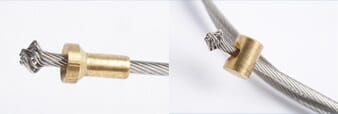
If you have purchased one of our cable kits then you will have been supplied Galvanised Steel inner wire. For galvanised steel you can use common electrical or plumbers solder which also has the flux combined. The higher the tin content of the solder the stronger it will be.
We recommend 'Black-band' or 'Frysol' soldering flux.
If you have purchased stainless steel inner wire (available separately) you will need special flux. For stainless steel wire we use ‘A8 Stainless Steel Flux’ and ‘Tinman Grade C (Lead based) solder’
Here at Venhill we use a flux reservoir and temperature controlled solder pots. We first dip the ‘bird caged’ end of wire into the flux with the nipple resting on top; only enough to cover the top of the nipple. Then submerge the wire and nipple into the molten solder (600F / 360C) again just enough to cover the top of the nipple. This ensures complete coverage of the nipple and wire to form the strongest bond possible without reducing flexibility of the wire.
The last stage is to grease the nipple and end of wire with light 3 in 1 oil.
If the part you require for your bike isn't listed on our website, please contact our technical department with the details of your bike and what part you are after so that they can inform you of what is needed to get the part you want. Please send an email to [email protected] with your enquiry.
In the wide world of motorcycles, there are thousands of different control cable and hydraulic hose designs, each serving a specific task and particular to the vehicle they are designed for.
In order to keep track of this, Original Equipment Manufacturers (commonly referred to as OEM) will often have the part number printed in some form on the cable or hose, so that installers can be sure that the correct part is going on the correct vehicle.
These part numbers usually have a particular structure to them, a numbering language unique to each manufacturer, so becoming familiar with this can be helpful when looking to source the correct parts for your bike.
OEM part numbers are usually made up of two or three segments, one segment will explain what the item is, with the remaining parts explaining what it fits. As the first segment of the part number is self-evident, it is rarely included on the cable or hose.
To findout more please follow this link https://tinyurl.com/y2vj4d69
- Powerhose is a DIY hose construction. We will supply braided hose cut to length and banjos with nut and olive to fit the ends of the hose. We recommend using our Mandrel tool (VT62) to open up the braiding when fitting the banjos to the hose, and to tighten up the socket nut. Without using this tool your brake hose is more likely to leak. A demonstration video for making Powerhose lines can be viewed by clicking the Powerhose link above.
- Powerhose Plus is Venhill's factory tested (TUV and DOT approved) brake line system designed to cut out the hassle and uncertainty associated with old style hoses. 'Powerhose Plus' brake lines are factory finished and are the same at both ends with 1/8th BSP swivel socket nuts which simply tighten on the chosen fittings for your machine.
Yes. Venhill Powerhose Plus lines have been formally tested and approved by TUV Rheinland. The test is in accordance with VSS106 standards. All Powerhose Plus lines are made to this standard. Venhill also has ISO 9001:2000 certification.
TÜV Product Service is an independent test body, which provides testing, certification, qualification, training and consultancy services to a range of industries. It has some of the best test facilities in Europe, and is recognised for independently testing and certifying a huge range of products, to make sure they meet the strict safety and quality standards required for sale and use worldwide. Visit them here.
You can also find the latest TUV Certificate to download at your convenience in our Application & Downloads section.
Yes. In addition to the TUV approval, our hose specifications have been sent to the United States Department of Transport and received authorization to claim that Venhill hoses meet the requirements as set forth by the DOT in accordance with the United States Federal Motor Vehicle Safety Standard No. 106, "Brake Hoses".
The DOT does not certify products. Compliance with the requirements is ‘self-policed’ by the manufacturer. Manufacturers submit product specifications to the DOT and receive permission to claim that the product meets DOT requirements. Whether or not the actual product you receive meets those requirements is up to the manufacturer. Every Venhill hose is built to the same specifications that were sent to the DOT, thus every hose meets (or exceeds) DOT standards.
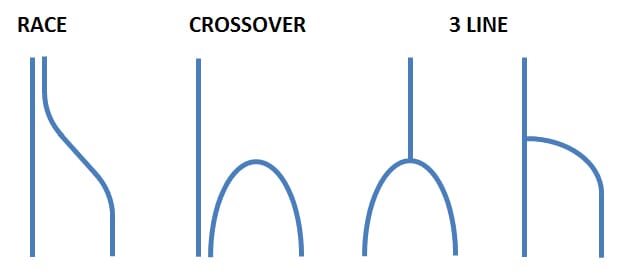
- 'Race' layouts are required by the ACU for twin caliper front brakes. Their regulations state that brake hoses should not be joined over the wheel, and specify: "...machines fitted with two front disc brakes, a split of the front brake lines for both front brake calipers must be made at or above the lower fork."
Our kits with 'Race' in the description have two lines from a double banjo at the master cylinder, with each line running to each caliper. - ‘Standard’ (AKA Three Line) layouts are standard on many European bikes. One line from the master cylinder to a 'T' piece, and then a line to each caliper. Generally, we offer what was standard on the bike and the alternative of a 'Race' option.
- ‘Crossover’ layouts have a line from the master cylinder to caliper, and a second line running from this caliper crossing over the mudguard to the other caliper. Many Japanese bikes have this layout as standard.
Rubber brake lines – often OEM fitment on motorcycles and cars – perish, harden and crack over time. This can allow the absorption of water into the brake fluid, reducing the efficiency of the braking system and putting other components at risk of corrosion.
As rubber brake lines age, they are also prone to expansion under pressure, reducing braking efficiency.
Braided steel brake lines eliminate expansion and water absorption, and will last the lifetime of the bike.
Yes, every hose we make is pressure tested to 1500psi (102 bar) and every 30 days we also test lines at random to 10,000psi (680 bar). Most motorcycle and car brakes systems operate at around 367-441psi (25-30 bar). Under hard braking on cars, pressures can reach 1000psi (68 bar).
- Check you have torqued up the swivel nuts to 12NM (just over hand tight). We sell a torque spanner set if needed.
- Note: Off road lines are usually tight one end (master cylinder) and left loose at the other end for you to align the hose and tighten.
- Road kits must be assembled completely with the fittings first loosely, then bolted up and tightened to their torque settings.
- Check you have tightened up all the banjo bolts to their recommended torque setting (15NM for our dome-headed bolts) and used a new copper washer each side of the banjo fitting.
- Adaptor fittings might require a copper washer between the mating face to get a seal. Note if the Venhill supplied adapter is shorter than the original; then the seal will be created on the shoulder of the adapter, and not the bottom of the thread inside the hole.
We sell -3 Hose, this equates to an O.D of 7.4mm with the PVC outer casing. Our uncovered hose has an O.D of 6.5mm.
- Swivel nuts should be torqued to 12NM. (Just over hand tight)
- Banjo bolts should be torqued to 15NM.
- Bleed nipples (As part of bleed nipple banjo bolts) should be torqued to 8NM
- Adaptors should be torqued to the same settings as the swivel nuts. (12NM)
Yes, certainly. We will soon be launching this as a feature on the product page, however in the meantime please email or ring our sales office and we can get the order raised for you.
Cables are made as replications of the corresponding OEM part. If you would like a cable made to suit Non-OEM or aftermarket equipment, please look at our Bespoke category.
Yes you can! Multiple copies, in the range of 1-4, are charged at our standard bespoke cable prices, 5 or more cables are charged at our normal stock cable prices. Prices are determined once we've had a chance to view the cable or drawing in it's entirety.